In 1978, a young space enthusiast named Michael Michaud wrote an essay that would never see print in its intended magazine, but whose ideas would quietly ripple through the corridors of interstellar thought. Titled Starships of the Mind, the piece laid out a compelling survey of the propulsion concepts that might one day carry humanity to other suns. When Michaud later corresponded with Alan Bond, the designer of the British Interplanetary Society's Project Daedalus, he shared a copy that had already passed through the hands of luminaries like Freeman Dyson and Robert Forward. The essay remains a testament to the power of imagination—the first and most essential starship we will ever build.
The Vision of Daedalus
Michaud wrote at a time when Project Daedalus had captured the imagination of engineers and dreamers alike. Conceived by the British Interplanetary Society in the 1970s, Daedalus was a fusion-propelled starship designed to reach Barnard's Star, nearly six light-years away, within a human lifetime. The design called for a two-stage vehicle powered by inertial confinement fusion, using pellets of deuterium and helium-3 ignited by electron beams. Michaud saw Daedalus not as a blueprint for immediate construction but as a proof of concept—a demonstration that interstellar flight was within the reach of physics, if not yet engineering.
Daedalus embodied the optimism of its era. It assumed technologies that were plausible but unproven, like magnetic confinement of the fusion plasma and the mining of helium-3 from the atmosphere of Jupiter. Yet Michaud recognized that the very act of designing such a starship was a voyage of the mind, pushing the boundaries of what we considered possible. As we continue to refine fusion research today, the spirit of Daedalus lives on in projects like the 100 Year Starship, which seeks to foster the kind of cross-disciplinary thinking that Michaud championed.
Nuclear Pulse: Riding the Shockwave
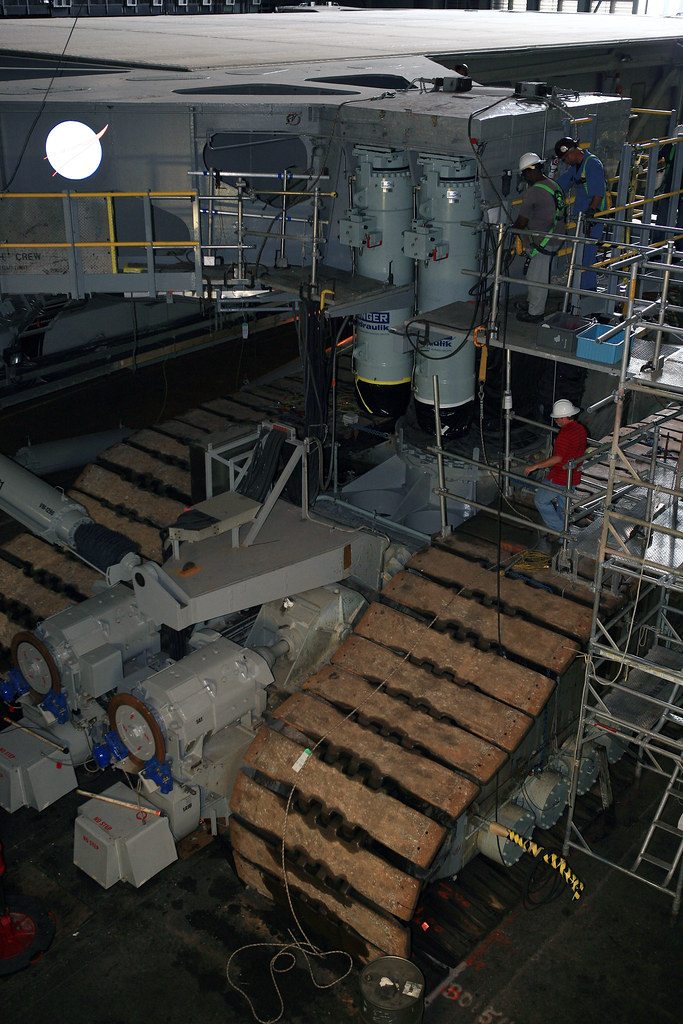
Long before Daedalus, there was Project Orion—a concept so audacious that it seemed torn from the pages of science fiction. First proposed in the 1950s, Orion would propel a massive spacecraft by detonating nuclear bombs behind a pusher plate, absorbing the shockwaves to generate thrust. Michaud discussed Orion in his essay as one of the earliest serious interstellar propulsion concepts. Though the 1963 Partial Test Ban Treaty drove the project underground, the physics remains sound: a properly designed Orion could theoretically reach significant fractions of light speed.
Michaud was careful to note the ethical and political hurdles, but he refused to dismiss the idea outright. He understood that interstellar travel might require us to revisit technologies we had set aside. In his optimistic view, the same ingenuity that had split the atom could also be turned to the peaceful purpose of reaching the stars. The lessons of Orion continue to inform modern research into pulsed propulsion, including concepts that use antimatter or micro-fusion explosions.
The Bussard Ramjet and Interstellar Resources
Another concept Michaud explored was the interstellar ramjet, proposed by physicist Robert Bussard in 1960. The idea is elegant: a starship could scoop up the thin hydrogen gas that fills interstellar space and use it as fuel for a fusion reactor, avoiding the need to carry all its propellant from Earth. Michaud saw the ramjet as a way to unlock the resources between the stars, turning the void itself into a highway.
Of course, the challenges are immense. The interstellar medium is extraordinarily tenuous, requiring magnetic fields of vast size to funnel enough hydrogen. Michaud acknowledged these difficulties, but he pointed out that the ramjet represented a philosophical shift: instead of carrying our environment with us, we would learn to live off the land, even in the emptiness of space. This idea resonates with modern concepts of in-situ resource utilization, from mining asteroids to harvesting water from ice dwarfs in the outer solar system.
Antimatter and the Ultimate Fuel
Of all the propulsion concepts Michaud surveyed, antimatter held a special place. When matter and antimatter meet, they annihilate with perfect efficiency, converting mass into energy according to Einstein's famous equation. A starship powered by antimatter could, in principle, achieve velocities close to the speed of light. Michaud knew that producing and storing antimatter was far beyond 1978 technology—and still is today—but he argued that the sheer elegance of the physics made it an inevitable destination for any advanced civilization.
Interstellar flight is not a question of if, but when—and the paths we imagine today become the starships of tomorrow.
The obstacles are not just technological; they are economic and energetic. Creating even a gram of antimatter would require colossal amounts of energy, and storing it safely demands magnetic bottles of unprecedented precision. Yet Michaud's optimism led him to believe that we would eventually overcome these hurdles, perhaps by building solar-powered antimatter factories in orbit or using particle accelerators of a scale we can barely conceive. Antimatter remains a cornerstone of speculative propulsion research, from Star Trek to the most advanced theoretical studies.
Light Sails and the Power of Light
Michaud also gave serious consideration to light sails, an idea that dates back to the early 20th century but gained new traction with the invention of the laser. A sail made of ultrathin reflective material could be pushed by sunlight or, more effectively, by a powerful laser aimed from Earth or from an orbital station. Because light exerts pressure, a sail-equipped spacecraft could accelerate continuously without carrying any fuel at all.
The concept has already moved from theory to practice: the Japanese IKAROS probe demonstrated solar sail propulsion in 2010, and the Planetary Society's LightSail missions have tested deployment in Earth orbit. Michaud would have been delighted to see these milestones. He noted in his essay that a laser-driven sail could theoretically reach a significant fraction of light speed, making it a leading candidate for sending small robotic probes to nearby stars like Proxima Centauri, where we have already discovered exoplanets. Modern efforts like Breakthrough Starshot aim to do exactly that, using a fleet of tiny sails propelled by ground-based lasers.
The Legacy of Optimism
What made Starships of the Mind so enduring was not the technical detail but the unshakeable optimism that infused every page. Michaud believed that the universe was not a wall but a door, and that the human spirit was the key. He saw interstellar travel not as an escape from Earth's problems but as an expression of our highest aspirations. The essay passed through the hands of Freeman Dyson, who himself had written about interstellar travel, and Robert Forward, who would go on to design a real antimatter rocket concept. They recognized a kindred soul.
Today, as we look back from deep space and send spacecraft like New Horizons to explore the outer reaches of our solar system, Michaud's vision remains as relevant as ever. The specific technologies may evolve, but the fundamental challenge is unchanged: to imagine a future beyond our current limits and then to work, patiently, toward it. The starships of the mind are the first step on a journey that will eventually carry us to the stars themselves.