Interstellar Expansion: Colonizing Ice Dwarfs
Are habitable planets the best places to look for life? The question seems odd, because we’re assuming life has to have clement conditions to emerge and survive. But step beyond the question of life’s formation and the issue can be framed differently. Where beyond its birthplace might life migrate? In SETI terms, where might we look for the signature of a civilization advanced enough to move beyond its home world and expand between the stars?
A lot of ideas seem to be converging here. In Huntsville, Ken Roy (whose description at the recent interstellar conference was ‘an engineer living and working amidst the relics of the Manhattan Project in Oak Ridge, Tennessee’) described potential habitats stretching far out into the Solar System and beyond. Roy has been working for some time with Robert Kennedy and David Fields on colonization scenarios.
My own talk covered the kind of places where we might extract resources, ranging from icy dwarfs like Pluto to cometary objects and ‘rogue’ planets without any star. And science fiction author Karl Schroeder, in a recent blog post called A Tale of Two Worlds, also brought the topic up. Let me quote Schroeder, because I want to return to his post in a day or so:
…it’s important to bear in mind that habitability and colonizability are not the same thing. Nobody seems to be doing this; I can’t find any term but habitability used to describe the exoplanets we’re finding. Whether a planet is habitable according to the current definition of the term has nothing to do with whether humans could settle there. So, the term applies to places that are vitally important for study; but it doesn’t necessarily apply to places we might want to go.
Both Schroeder and Roy are assuming not near-term projects but the kind of settlement and terraforming that draw on huge resources of energy. The premise, in other words, is that we’re talking about a culture that ranges freely through its own system, having mastered fusion or other technologies and being capable of large-scale building projects in space and on planetary or other surfaces. Grant that premise and then think about what kind of structures it might make sense to build when exploiting local resources and looking out toward the stars.
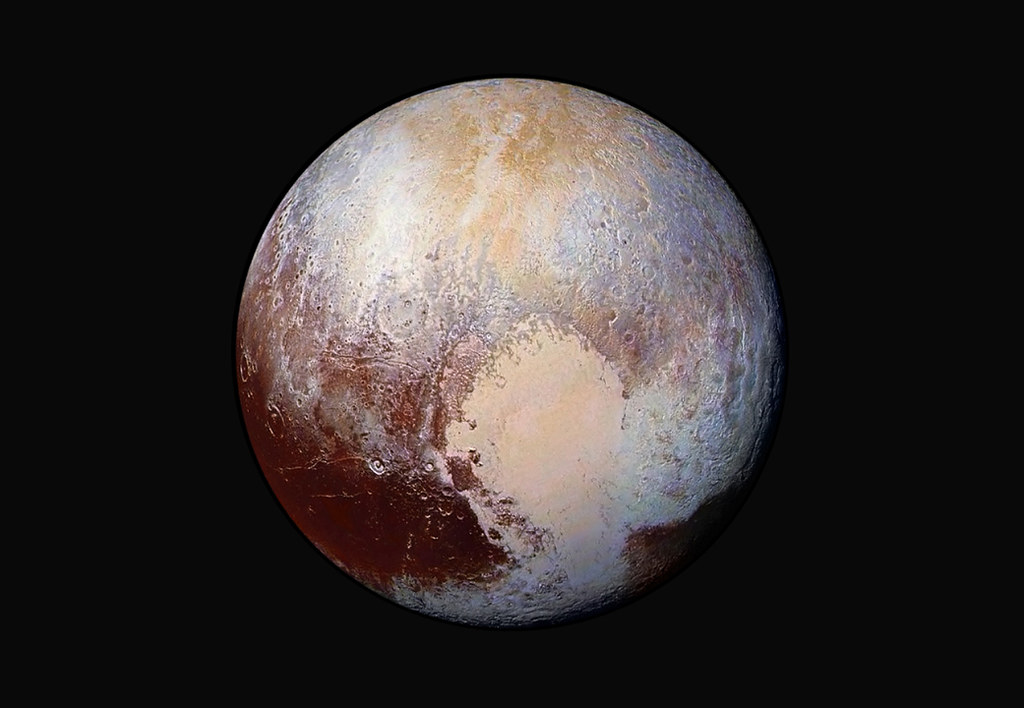
Pluto is a case in point. Here we have a surface that appears to be a shell of nitrogen ice covering water ice. When New Horizons gets to the Pluto/Charon binary in 2015, one thing to look for is an equatorial bulge that could have been left over from the early days of Pluto’s formation. No bulge makes the case for stretching of the ice shell over Pluto’s lifetime, strengthening the possibility some are noting that the ice dwarf could contain an ocean beneath about 165 kilometers of crust, an ocean that may be just as deep as the crust is thick (see The Case for Pluto’s Ocean for more).
As Roy told the crowd in Huntsville, icy worlds like Pluto are rich in volatiles, and of the tens, if not hundreds of thousands of Kuiper Belt objects out there between 30 and 50 AU, several hundred may be Pluto-size. Such worlds are doubtless common not just here in our own system but as rogue planets in interstellar space and perhaps circling brown dwarfs, those dim objects that blur the distinction between gas giants like Jupiter and true stars like Proxima Centauri.
Image: This artist’s conception of the ‘scattered disk’ object Sedna reminds us that even beyond the Kuiper Belt and as we move into the Oort Cloud, vast numbers of icy objects are thought to exist. Can we exploit these as we move outward toward another star?
Build a settlement on an ice dwarf in the outer system and you are not only creating space for living and doing science, but also building the technologies that will one day be used in interstellar colonization missions. But Roy noted that the science fictional image of a domed city in a harsh landscape just won’t work here. Induce Earth-class atmospheric pressure inside such a dome and even a small one (1000 feet in radius) would require a four-inch thick layer of steel to keep the dome intact. Moreover, ice dwarfs have but feeble gravity, creating medical issues from muscle atrophy to bone problems, loss of body mass, sleep disturbance and more. A better choice, then, is to move inward, creating the colony deep within the ice dwarf itself.
At 160 meters, the ceiling of a colony hollowed out within Pluto would be fully supported by the air pressure inside. Artificial light would be essential, of course, and we still have a gravity problem, for Pluto’s gravity is only 6.7 percent that of the Earth — a 200 pound person on Earth weighs but 14 pounds on Pluto. Roy suggests a rotating torus in this setting could provide living and working spaces at 1 Earth gravity. At 1 revolution per minute, a 1790-meter torus supported by maglev rails could accommodate, by Roy’s estimation, 10,000 people living in conditions that would more or less resemble the worldships so often imagined by science fiction writers.
We’re assuming technologies that can create large rotating structures in low-gravity environments, with the ability to move spacecraft at velocities of 0.001 c to build and supply the colony. We’re also assuming proven fusion power plants and considerable expertise in mining and construction. We would put these tools to work to extract local silicates and metals from the surface and, perhaps, rock from buried impactors. We would be working in an environment rich in H2O, but also in methanol, hydrogen cyanide, formaldehyde, ethanol, ethane and long-chain hydrocarbons, all within a salty ice mantle.
Here’s long-haul migration to the stars presented as a series of steps at 0.001 c. Moving roughly 400 AU at a time between various objects in the outer system and, eventually, interstellar space, we spend 50 years at each to establish a colony and then build and crew another ship. The 4.2 light years to Proxima Centauri in this scenario demands 664 such jumps and reaches the star in 38,000 years, leaving a chain of colony worlds behind that are self-sustaining.
The technologies needed for this kind of expansion are well beyond us, but it is not inconceivable that more advanced cultures as they move up the Kardashev scale may have accomplished such things. Places that are habitable, as Karl Schroeder says, are not the same thing as places that are colonizable, and it’s also true that we have to be wary of imputing human motivation to hypothetical extraterrestrial civilizations. Their detectable artifacts, in other words, might extend between the stars far into the interstellar deep and so, in some remote futurity, might ours.
The Torus Habitat: Engineering a World Inside a World
The rotating torus, as Roy envisions it, would be a colossal ring structure suspended within a precisely excavated cavern. Supported by magnetic levitation, it could spin frictionlessly at one revolution per minute, generating a full Earth gravity along its inner surface. The cavern itself, hollowed out at a depth where the ice provides structural integrity against internal air pressure, would be large enough to house not only the torus but also industrial zones, storage areas, and transit systems. Excavation would likely rely on a combination of thermal drilling and mechanical cutting, with the removed ice processed for water, oxygen, and hydrogen.
Building materials for the torus—metals, composites, and advanced ceramics—would be refined from the rocky and metallic constituents mixed within the ice. The ice shell above provides natural shielding against cosmic rays and micrometeoroids, reducing the need for heavy artificial radiation protection. Inside the torus, cities, farms, and parks could be arranged in terraced rings, with sunlight simulated by full-spectrum lighting tuned to Earth's diurnal cycle. The scale is immense: a torus of 1,790 meters in radius and, say, 150 meters in cross-sectional diameter would provide over 1.5 million square meters of living space—enough for a population far larger than the 10,000 Roy estimates, depending on density.
Powering the Colony: Fusion and Beyond
Energy for such a colony would come primarily from nuclear fusion, using deuterium extracted from the abundant water ice. A single ice dwarf like Pluto contains enough deuterium to power a civilization for millions of years. Fusion reactors could be placed deep within the ice, where the surrounding material serves as both containment and heat sink, with waste heat used to maintain habitable temperatures in the outer shell. Alternatively, advanced fission or even matter-antimatter annihilation could be considered, but fusion remains the most plausible near-term—by interstellar colonization standards—energy source.
In addition to powering life support and industry, the colony would need energy for propulsion if it ever became a spacecraft. As discussed in Resources Between the Stars, ice dwarfs and comets are essentially pre-packaged fuel depots, with water ice that can be electrolyzed into hydrogen and oxygen for chemical rockets or used directly as reaction mass for nuclear thermal or ion drives. A self-sustaining fusion economy would make the ice dwarf not just a home but a potential vehicle.
Mining the Ice: Resources for Survival and Expansion
The interior of an ice dwarf is a treasure trove of volatiles and minerals. Water ice dominates, providing oxygen for breathing, hydrogen for fuel, and, when combined with nitrogen from the surface layers, breathable air. Carbonaceous material, likely present in the form of complex organic molecules mixed into the ice, could supply carbon for plastics, polymers, and even food production through hydroponics. Rocky inclusions—silicates, metals, and possibly even rare earth elements—would be mined and refined using automated systems, as the low gravity makes traditional heavy machinery unnecessary.
- Water ice: life support, radiation shielding, propellant
- Nitrogen ice: atmosphere buffer, fertilizer
- Carbon compounds: plastics, fuels, organic feedstock
- Silicate rock: construction aggregate, glass, ceramics
- Metallic ores: structural materials, electrical conductors, machinery
The sheer volume of material available means the colony could expand nearly indefinitely, adding new caverns and additional tori as the population grows. The mining operations themselves would be entirely automated, with human oversight from control centers inside the torus, minimizing risk and maximizing efficiency.
From Ice Dwarf to Interstellar Ark
The skills and technologies required to colonize an ice dwarf are precisely those needed for interstellar travel. A self-sustaining habitat with closed-loop life support, in-situ resource utilization, and long-term energy generation is the core of any generation ship concept. As argued in Starships of the Mind, the psychological and sociological challenges of a centuries-long voyage demand a stable, comfortable environment—exactly what a well-designed torus inside an ice body provides.
Moreover, an ice dwarf could itself become the ark. By attaching propulsion systems—perhaps a large fusion drive using ice as propellant—the entire body could be nudged out of its orbit and sent on a trajectory to another star. The thick ice shell would protect inhabitants from interstellar radiation and impacts, and the colony would have everything needed for the journey and for establishing a new settlement upon arrival. Such a mission would take thousands of years, but a civilization that has already mastered fusion and large-scale space construction may think in such timescales.
The Long View: Society and Adaptation
Life inside a hollowed ice dwarf would be profoundly different from Earth, yet the artificial environment inside the torus could be made nearly indistinguishable from a terrestrial city. With a full Earth gravity, a 24-hour light cycle, and carefully maintained ecosystems, the inhabitants might forget they live under kilometers of ice. Over generations, however, cultural and perhaps biological adaptation would occur: a people accustomed to enclosed spaces and finite resources might develop a strong conservation ethic, and their view of the cosmos might be shaped by the knowledge that their entire world is a human construction.
The colony would be a microcosm of what an interstellar civilization might become: decentralized, self-sufficient, and capable of surviving for millions of years on internal resources alone. It would also be a stepping stone—a testbed for the technologies and social structures that will eventually carry humanity to the stars. As we continue to explore our own outer solar system with missions like New Horizons, we are gathering the data needed to plan such ventures. The ice dwarfs are not just frozen relics of the solar system's formation; they may be the cradles of our future expansion.